
Why Pakistan Needs More Provinces: Should Karachi Become a Separate Province?
Pakistan is a large and diverse country with rapidly growing cities, expanding populations, and very different economic and administrative needs. As the population increases and urban centers become more important, it is reasonable to debate whether the country’s existing provincial structure remains the most effective way to deliver good governance, infrastructure, public services, and economic development.
One proposal that deserves serious discussion is the creation of more provinces in Pakistan, including the possibility of establishing Karachi as a separate province or a specially governed metropolitan region.

Karachi Real Estate
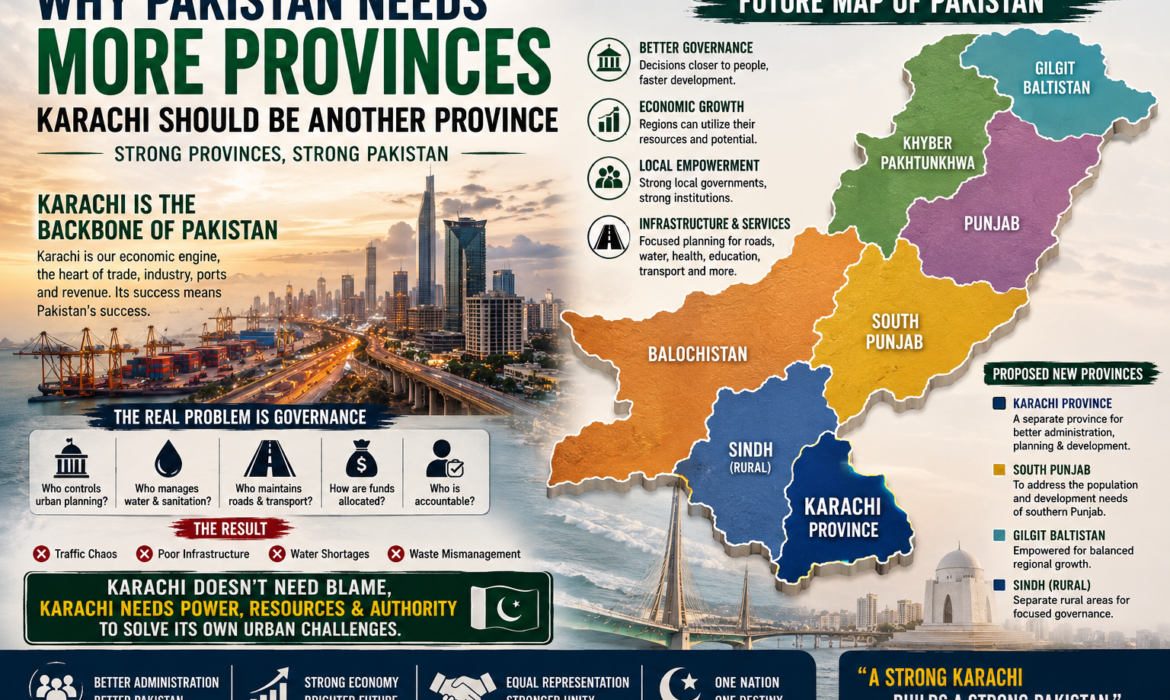
Karachi Is the Economic Backbone of Pakistan
Karachi is one of Pakistan’s most important economic centers. It is a major commercial city, financial hub, industrial center, and port city. Businesses across the country depend on Karachi’s transportation networks, ports, markets, financial institutions, industries, and workforce.
Because Karachi contributes enormously to Pakistan’s economy, its governance should be treated as a national economic priority.
When roads deteriorate, public transport becomes inadequate, water systems fail, waste management struggles, or urban planning becomes ineffective, the consequences are not limited to Karachi residents. They can affect investment, employment, trade, and Pakistan’s wider economy.
Why Consider More Provinces?
Pakistan’s existing provinces cover enormous populations and territories. Managing highly populated metropolitan areas through distant provincial administrations can create challenges.
Creating additional provinces could potentially bring government closer to citizens. Smaller administrative units may allow governments to focus more directly on local infrastructure, education, healthcare, transportation, water management, taxation, and urban development.
However, creating provinces alone would not solve every problem. New administrative boundaries must be accompanied by transparent institutions, effective local governments, financial accountability, and competent planning.
Why Karachi Could Require a Different Administrative Model
Karachi is unlike most other parts of the country because it is a huge metropolitan area with complex urban requirements. Its population, industries, ports, commercial districts, housing developments, informal settlements, transportation demands, and environmental challenges require specialized metropolitan planning.
A separate Karachi province is one possible model. Another possibility would be a powerful metropolitan government with clearly defined authority over transportation, water, waste management, planning, taxation, and municipal services.
The objective should not be to blame an ethnic community or political group. Karachi belongs to all Pakistanis and to its diverse residents, including Sindhis, Urdu-speaking communities, Punjabis, Pashtuns, Baloch, Gilgitis, Kashmiris, and many others.
The Real Problem Is Governance
Karachi’s difficulties should be examined through governance rather than ethnic blame.
Questions should include:
- Who controls urban planning?
- Who collects taxes?
- Who controls water and sanitation?
- Who is responsible for public transportation?
- Who maintains roads?
- How are development funds allocated?
- Who is accountable when projects fail?
- Does the city have sufficient authority to manage its own resources?
These questions are more productive than blaming an entire ethnic population.
Karachi Needs Greater Financial and Administrative Authority
If Karachi is expected to contribute significantly to Pakistan’s economy, it should have an administrative structure capable of maintaining the infrastructure required for that economic activity.
A stronger governance system could prioritize mass transit, roads, drainage, water supply, waste management, housing, industrial zones, digital government, public safety, and environmental protection.
Karachi also needs long-term urban planning rather than short-term political responses.
 More Provinces Could Strengthen Pakistan
Creating additional provinces should not be viewed automatically as a threat to national unity. If designed carefully, smaller administrative units could potentially improve representation and service delivery.
The goal should be a Pakistan where citizens can reach government institutions more easily, public money is transparently managed, and development decisions reflect local needs.
Any proposal for new provinces should be based on constitutional procedures, public consultation, economic feasibility, geographic considerations, and administrative capacity.
Conclusion
The debate about new provinces in Pakistan deserves serious, peaceful, and evidence-based discussion. Karachi’s enormous economic importance means that its governance cannot be treated as an ordinary administrative question.
Whether the solution is a separate Karachi province, a powerful metropolitan government, or another constitutional arrangement, the central objective should remain the same: better governance, stronger infrastructure, greater accountability, and sustainable economic growth.
Karachi does not need ethnic blame. Karachi needs effective government, transparent institutions, proper planning, financial responsibility, and the authority to solve its own urban problems.
A stronger Karachi can contribute to a stronger Pakistan.